

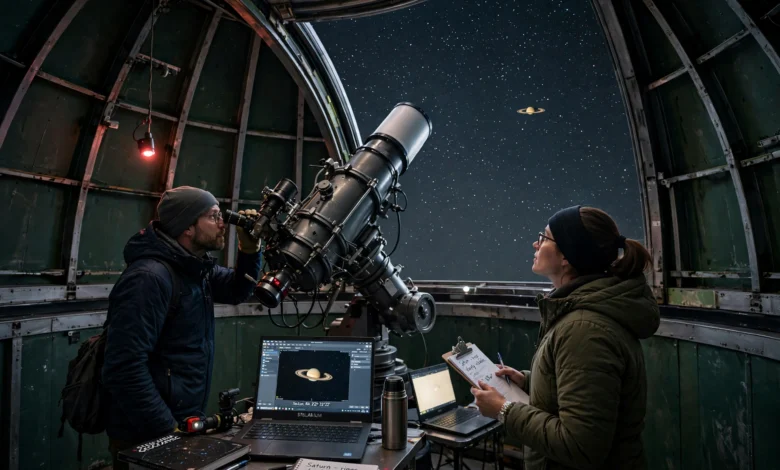
The solar system’s moon championship has a runaway winner. Astronomers have confirmed 128 new moons of Saturn, raising the planet’s recognised total to 274, by far the largest tally around any planet. The discoveries emerged from a long-running survey using the Canada-France-Hawaii Telescope on Mauna Kea, with researchers at the University of British Columbia playing a central role in tracking the faint objects and calculating their orbits. The International Astronomical Union has now formally recognised the additions. Readers who follow launches as closely as planets can revisit our report on the SpaceX launch that painted the East Coast sky.
A survey built on patience
None of these moons is a grand world like Titan. Most measure only a few kilometres from side to side and shine so faintly that they hide among background stars in ordinary images. The survey team used a technique sometimes called shift-and-stack: dozens of exposures were digitally shifted to follow Saturn’s motion and then combined, allowing objects far too dim for a single photograph to emerge from the noise. Repeated observations across several years let the astronomers connect each candidate’s positions into an orbit, the essential proof that a moon is gravitationally bound to Saturn.
Families born from ancient collisions
The newcomers mostly belong to irregular moon populations, groups travelling on tilted, elongated orbits far from Saturn’s equator. Their clustering is a clue to their origin. Astronomers believe many began as single larger moons or captured asteroids that later shattered in collisions, scattering fragments along similar paths. Reading those patterns is like reading a family tree written in gravity. Some groups may be surprisingly young in cosmic terms, the debris of impacts that happened long after the planets formed, which makes Saturn’s outer system a live record of the solar system’s restless middle age.
How the other planets compare
Jupiter, for decades the presumed moon king, now sits well behind with 95 confirmed moons. Uranus has 29 and Neptune 16, although both ice giants are so distant that their counts are widely expected to grow as instruments improve. Mars has two small moons, while Earth, Venus and Mercury make do with one or none. The comparison is not entirely fair: Saturn has simply been searched more thoroughly in recent years, with observing time devoted to exactly this hunt. Even so, a lead of nearly three to one is a striking result by any measure.
Why the catalogue matters
A complete census underpins almost everything else planetary scientists want to know. Moon counts constrain models of how giant planets formed and migrated, how much material once swirled around them, and how often collisions reshaped their systems. The new moons also give mission planners a fuller map of the environment their spacecraft must navigate. Publications such as {NAT} regularly carry the follow-up studies that turn raw discovery lists into physical understanding, from measurements of a moon’s colour to estimates of when its parent body broke apart.
The archive that keeps on giving
A significant share of the survey’s images were taken years before the moons within them were recognised, which makes the archive itself one of the stars of this story. Astronomical data, carefully stored, appreciate in value as software improves and as new questions are asked of them. Images gathered to study Saturn’s known moons have now yielded 128 unknown ones, and nobody would bet against the same frames producing more after the next processing pass. It is a standing argument for open, well-kept scientific archives: the discovery you fund today may be the raw material for a discovery nobody has imagined yet, made by a researcher who was still at school when the telescope shutter opened.
More moons are surely out there
The team behind the survey is candid that the count will keep climbing. Each generation of cameras reaches fainter objects, and there is no natural finishing line, only a practical one set by telescope time and the difficulty of confirming ever-smaller bodies. At some point the community must also agree how small an orbiting rock can be before it is classed as ring debris rather than a moon. Until then, the headline stands, and it is a delightful one: Saturn, already the showpiece of the night sky, now wears the crown for moons as decisively as it wears its rings.


