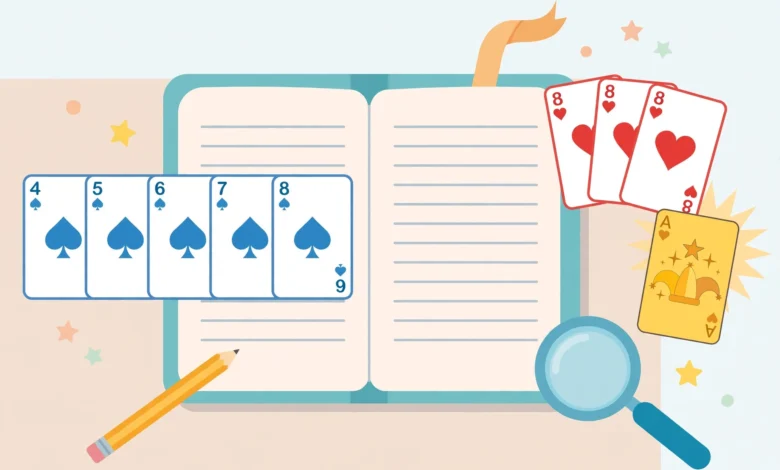
Sit down at a rummy table for the first time and the conversation can sound like a foreign language. Someone “drops” before you have even settled in, another player “declares” with a flourish, and everyone seems very concerned about your “deadwood”. The good news is that rummy vocabulary is small, logical and easy to pick up. This glossary decodes the essential terms so you can follow the game — and sound like a regular — from your very first hand.
The Building Blocks
Meld
To meld is to lay down a valid combination of cards on the table. Every winning hand in rummy is built from melds, so this is the game’s foundational idea: your thirteen cards must be organised into proper groups before you can finish the round.
Sequence (or Run)
A sequence is three or more consecutive cards of the same suit, such as 5-6-7 of hearts. A pure sequence is formed without a joker, while an impure sequence uses a joker to stand in for a missing card. In 13-card rummy, at least one pure sequence — often called your “life” — is compulsory before any declaration can count.
Set (or Trail)
A set is three or four cards of the same rank in different suits, such as three queens. Unlike sequences, sets may use jokers freely, but note that duplicate suits are not allowed within a set — two queens of hearts do not make a valid pairing here.
Joker
The joker is rummy’s great rescuer. Each game has a randomly selected “wild” joker rank, alongside the printed jokers in the deck. A joker can substitute for almost any card in a sequence or set — but it can never be counted inside a pure sequence, which must be built the honest way.
The Flow of the Game
Draw and Discard
Every turn has two beats: draw one card, either from the face-down stock pile or from the top of the discard pile, then discard one card you do not need. Watching what opponents pick up and throw away is where much of the strategy lives, so pay attention even when it is not your turn.
Drop
To drop is to fold your hand and leave the round. A “first drop”, made before you have taken a turn, costs the fewest penalty points; a “middle drop” later in the round costs more. Dropping early with a hopeless hand is not cowardice — it is good rummy, and experienced players do it without hesitation.
Declare
To declare is to announce that your hand is complete: every card arranged in valid sequences and sets, with the final discard made. A correct declaration wins the round. An invalid declaration, where a combination fails to check out, carries a heavy points penalty, so count your cards carefully before you call it.
Points
Points decide the damage when a round ends. Kings, queens, jacks and aces carry ten points each, number cards carry their face value, and jokers carry none at all. When you declare successfully, each opponent scores penalty points equal to the deadwood left in their hand — so in rummy, losing narrowly matters almost as much as winning.
Deadwood
Deadwood is the name for the cards left unmatched in your hand when an opponent declares. Those cards convert into penalty points against you, which is why experienced players steadily reduce their deadwood as a round develops instead of clinging to hopeful combinations.
Putting It Into Practice
Reading definitions is a fine start, but rummy terms truly click once you hear them used in play. The quickest way to build that fluency is to sit at beginner-friendly tables and play a few low-pressure games; platforms such as Love Rummy are a handy place to practise the vocabulary in real matches until words like “meld” and “declare” feel like second nature.
Start with the essentials — meld, sequence, set, joker, drop and declare — and the rest of the language will fall into place within a few sessions. Before long, you will be the one explaining deadwood to the newest player at the table.