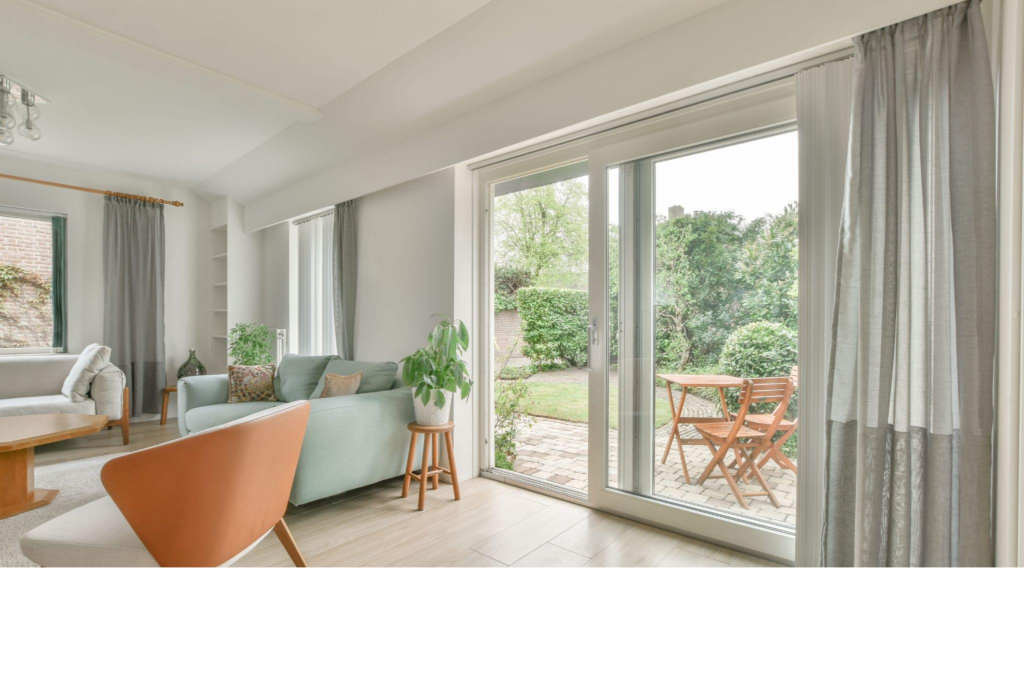
Most people don’t think about the difference until they’re standing in a half-demolished living room, quote in hand, wondering why one door costs so much more than the other. Both are glass panels on a track. Both slide. So why the price gap, and why do builders keep asking, “Are you sure you don’t want a stacker?”
The short answer is that a sliding door and a stacker door solve different problems. Here’s the longer one.
How Each Door Actually Works
A standard aluminium sliding door has two panels, sometimes three. One is fixed in the frame and the other glides in front of it. However wide the door is, you only ever get about half of it as an opening. On a 3-metre door, that’s roughly 1.5 metres to walk through. It’s fine for carrying a laundry basket, but a bit tight for a barbecue and a few extra chairs.
A stacker door is built from multiple panels, often three, four or more. Instead of one panel doing all the moving, several panels slide independently on their own tracks and park behind one another, like cards fanned out in a hand. Push them all aside and you can free up two-thirds or more of the opening, depending on the layout. Some designs stack to one side, and others split and stack to both ends so the middle opens completely.
The glass looks the same either way. What you’re really buying with a stacker is a usable opening.
When a Sliding Door Makes More Sense
Don’t let anyone talk you into a stacker if you don’t need one. A sliding door is the better pick when:
- The opening is modest. For a bedroom, a laundry, or a small balcony, an extra panel adds cost without adding much.
- You’re working to a budget. Fewer panels, less track and simpler hardware means a lower price, and money saved here can go toward better glass or a nicer finish.
- You want fewer moving parts. Two panels and one set of rollers is about as low-maintenance as a door gets.
- It’s a rental or a secondary entry. Not every door needs to be the star of the show.
When a Stacker Door Earns Its Price
A stacker comes into its own when the door is more than a door and becomes part of how the house works:
- You entertain outdoors. If your kitchen or living area flows onto a deck or alfresco, a wide opening makes the two spaces feel like one room.
- You have a view worth showing off. Pool, garden, bush, water, whatever it is, a stacker lets the outdoors in instead of framing it like a postcard.
- You like adjustable ventilation. Cracking one panel for a cross-breeze on a mild evening, then opening everything for a summer gathering, is the sort of flexibility a two-panel slider can’t offer.
- You’re renovating a tired wall. Replacing a solid wall with a wide glazed span is one of the few upgrades that changes how a home feels day to day.
Practical Things Worth Checking Before You Commit
This is where people either save themselves a headache or buy one.
- Weight and rollers. Stacker panels are big and heavy, especially with double glazing. The rollers carry all of that weight, so ask what they’re made of and how many each panel has. A well-built panel should move with a light push. If a showroom model feels stiff, imagine it after five years of dust and humidity.
- The track. Raised tracks are sturdier but are a trip hazard, and they trap grit. Low-profile or recessed tracks look cleaner and are easier to step over and sweep. If you have kids or older relatives, this matters more than it sounds.
- Glass choice. Large glass areas can turn a living room into a greenhouse on a hot afternoon, particularly with western exposure. Double glazing and low-E coatings help with both heat and noise. Safety glass is a requirement for doors, and in some locations the glass specification is also driven by wind or bushfire ratings.
- Sealing. Look closely at the weather strips, the interlocks between panels, and how water drains from the bottom track. A stacker has more joins than a slider, so the quality of those details counts. Ask whether the product is tested against the relevant Australian Standards for windows and external glazed doors.
- Locking. One latch on a three-metre panel isn’t much comfort. Ask about multi-point locking and what the lock engages with.
- Flyscreens. A wide opening invites more bugs. Check whether the screens stack as neatly as the glass, or whether you’ll be wrestling a bulky screen every evening in mozzie season.
- Structure above the opening. If you’re widening a wall, the lintel or beam above has to be sized for the new span. That’s a job for a builder or engineer, and it can add to the budget. Better to hear it before ordering than after.
Why Aluminium Is the Common Choice
Frame material matters more with large doors. Aluminium is strong enough to hold big glass panels in slim frames, so you get more glass and less frame. It doesn’t swell, rot, or warp the way timber can, and powder-coated finishes cope well with sun and, with the right coating, salt air. A thermally broken frame, which has an insulating barrier between inside and outside faces, helps with energy efficiency, too.
That’s why many local fabricators, including Aussie Aluminium Enterprise, concentrate on made-to-measure aluminium doors and windows. Custom sizing means you aren’t forced to design your opening around a standard door off the shelf. It also helps to deal with a business that is close enough to visit, measure properly and look after the door after it’s installed.
A Simple Way to Decide
- Try this. Stand where the door will go and picture a typical weekend.
- If you mostly walk through it, a sliding door will serve you well.
- If you picture people spilling in and out, with the whole wall open and the breeze moving through, a stacker door is probably what you want.
- If you’re still torn, a stacker often wins on the day you first open it fully, and a slider wins on the day you see the invoice. Only you know which day matters more.
Questions People Often Ask
- Can a stacker door open completely? Not entirely. The stacked panels still occupy some of the opening, but a good layout leaves most of it clear.
- Are stacker doors harder to operate? Not if they’re well made. Good rollers and clean tracks keep them easy to move. Problems usually come from cheap hardware or neglected tracks.
- Do they need much maintenance? Mostly just cleaning the tracks, wiping the frames, and occasionally lubricating the hardware.
- Are they secure? They can be, with quality multi-point locks and appropriately specified glass. Always ask how the door locks, not just how it looks.
Final Word
Neither door is better in every situation. A sliding door is practical and economical, and a stacker door is the better choice when you want the house to open up to the outdoors. Before you decide, measure your opening, think about how you actually live, and have a chat with a local specialist like Aussie Aluminium Enterprise. A good supplier will tell you honestly which one suits your home, even if it’s the cheaper option.