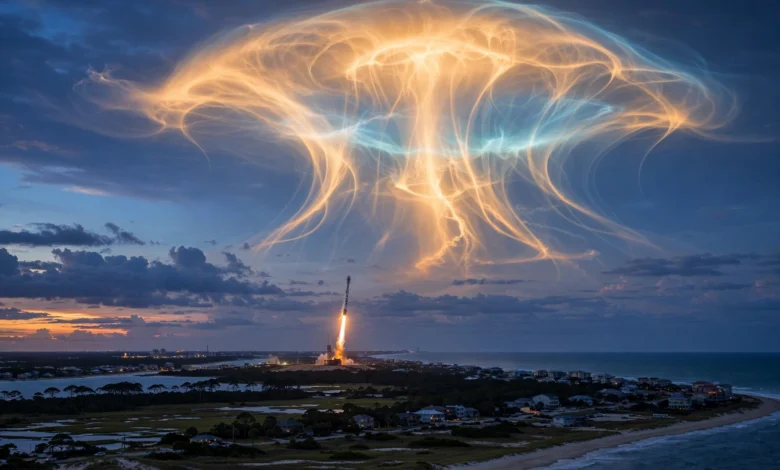
People along the US East Coast looked up this week to find something extraordinary hanging in the twilight sky: a vast, glowing, jellyfish-shaped cloud, its translucent tentacles spreading far beyond the path of the rocket that created it. The cause was a SpaceX launch timed, almost perfectly, to catch the light of a sun that had already set for viewers on the ground. Photographs shared from beaches, suburbs and city rooftops showed the same luminous bloom from hundreds of miles apart, and for a few minutes an ordinary evening became a shared moment of wonder.
What Is a Jellyfish Cloud?
A jellyfish cloud, sometimes called a space jellyfish, forms when a rocket climbs into the upper atmosphere during twilight. On the ground, night has fallen, but at altitude the rocket and its exhaust plume are still in direct sunlight. The exhaust expands rapidly in the thin air, creating a wide, diffuse cone of vapour and ice crystals. Sunlight passing through that plume makes it glow against the darkening sky, while the narrower, brighter core resembles the bell of a jellyfish and the trailing exhaust forms its tentacles.
Reporting on the phenomenon by The Guardian described how widely the display was seen along the eastern seaboard. It is not a cloud in the weather sense at all, which is why it can appear so sharply defined and move so differently from anything a storm system would produce.
Why Timing Matters So Much
The effect depends on a narrow window. Launch too early, in full daylight, and the plume is washed out by a bright sky. Launch too late, in full darkness, and there is no sunlight at altitude to illuminate it. The most spectacular displays happen roughly 30 to 60 minutes before sunrise or after sunset, when the contrast is greatest. Season, latitude and the rocket’s trajectory all shape what viewers see, which is why two launches from the same pad can look completely different.
Technology is making these moments easier to anticipate and share. As we explored in our look at how AI agents are quietly taking over routine office work, automated systems now handle everything from scheduling to real-time alerts — including the launch notifications that send photographers outside at exactly the right moment.
A Reminder of How Busy Orbit Has Become
Beyond the beauty, the jellyfish cloud is a visible sign of a deeper change: launches are no longer rare events. Commercial crews, satellite internet constellations and national missions now lift off so frequently that coastal residents treat the rumble as routine. Each mission adds capability — communications, Earth observation, navigation and science — and each twilight launch gives millions of people a direct, unaided view of that activity.
That visibility matters for public understanding. It is one thing to read about orbital infrastructure; it is another to watch it draw light across your own sky. Teachers have seized on these moments, a shift we noted in the evolving relationship between students and teachers in the AI era, where real-world events increasingly anchor classroom discussion.
How to Catch the Next One
If you live within a few hundred miles of a launch site, your chances are good. Follow launch schedules, favour twilight windows, and find a spot with a clear, dark horizon in the direction of the pad. Give your eyes a few minutes to adjust, keep your phone ready, and use a longer exposure if you can — cameras often reveal colours and structure that the eye only hints at. Binoculars help once the plume expands, though the best views are usually with the naked eye.
The Bottom Line
The jellyfish cloud over the East Coast was not an anomaly, a secret test or a weather event. It was sunlight, physics and timing, made visible by a rocket doing its ordinary work at an extraordinary hour. As launch cadence rises, these brief sky shows will become a familiar part of coastal life — and each one is a small, luminous reminder of how present spaceflight has become in everyday life.