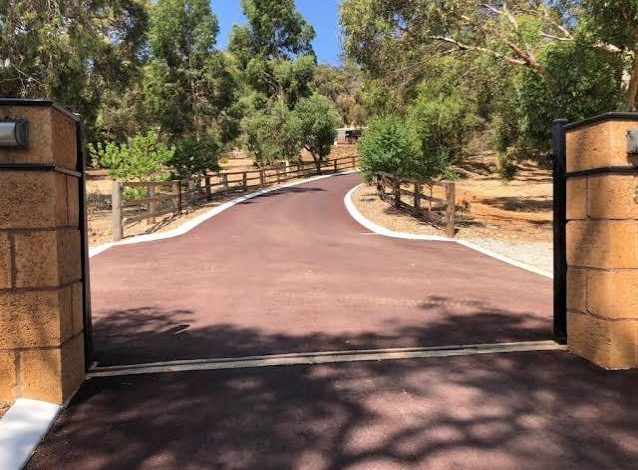
Rural and acreage properties bring a completely different set of driveway considerations to a standard suburban block. You are not just paving a short stretch from the street to a garage. You might be building a driveway that runs fifty metres, a hundred metres, or considerably further, across uneven ground, through drainage lines, and under the full weight of WA’s summer heat and winter downpours. The material you choose has a much bigger impact on cost, durability and ongoing maintenance when the driveway is long, exposed and subject to heavier loads from trucks, trailers and farm equipment rather than the odd sedan pulling in and out each day.
Why Driveway Length Changes the Decision Entirely
On a typical suburban block, the cost difference between bitumen, asphalt and concrete over a ten or fifteen metre driveway is usually modest enough that the decision comes down mostly to appearance and personal preference. On a rural property, that same per metre cost difference gets multiplied many times over across a driveway that might run well beyond a hundred metres, which means the material choice has a genuinely significant impact on the total project cost. This is exactly why rural landowners need to think about this decision differently to someone paving a short city driveway, weighing not just the upfront cost per square metre but how that cost compounds across a much longer run, and how each material actually performs once installed across varying ground conditions rather than a single flat, prepared surface.
Bitumen, Asphalt and Concrete: What Each Material Actually InvolvesBitumen and Recycled Bitumen for Long Rural Runs
Bitumen, including recycled bitumen made from reclaimed asphalt material, tends to be one of the more cost effective options for long rural driveways, which is a big part of why it remains so popular across acreage properties in WA. It installs relatively quickly, handles the flex of ground movement reasonably well compared with a rigid surface like concrete, and recycled bitumen in particular offers a more budget friendly option without sacrificing much in the way of durability for typical rural traffic loads. The trade off is that bitumen surfaces generally need resealing every several years to maintain their condition, and they can soften slightly in extreme heat, which is worth factoring in for driveways that sit fully exposed to direct summer sun across much of the day.
Asphalt Driveways and Where They Fit
Asphalt sits in a similar family to bitumen but is typically a more refined, consistently graded product, often associated with a smoother finish and slightly longer lifespan when properly installed and maintained. For rural properties, asphalt can be a strong middle ground option, offering a more polished result than recycled bitumen while generally remaining more cost effective than a full concrete driveway across a long run. Like bitumen, asphalt will need periodic resealing or resurfacing over its life, and it performs best when there is reasonably solid, well compacted ground beneath it rather than soft or poorly drained sections that could lead to uneven settling over time.
Concrete Driveways for Durability and Low Maintenance
Concrete represents the most durable and lowest maintenance of the three main options, and this becomes particularly relevant on rural properties carrying heavier vehicles such as trucks, machinery or horse trailers on a regular basis. A properly installed and reinforced concrete driveway can comfortably handle this kind of load for decades with minimal upkeep beyond the occasional crack repair or resealing of joints. The trade off is cost. Concrete is generally the most expensive option per square metre of the three, and on a long rural driveway, that cost difference can become substantial once multiplied across the full length of the run.
When Concrete Genuinely Justifies the Extra Cost
Concrete tends to make the most financial sense in specific sections of a rural property rather than necessarily across the entire driveway length. A short, heavily trafficked section near sheds, garages or areas where vehicles regularly turn and manoeuvre often benefits most from concrete’s durability, while the longer, straighter run connecting that area to the road might be better served by a more cost effective material like bitumen or asphalt. This hybrid approach, mixing materials across different sections of the same driveway based on actual use patterns, is common on larger rural properties and can deliver a more sensible balance between cost and longevity than committing to a single material across the entire length.
Ground Conditions and Drainage: The Factor Most People Underestimate
Whatever material you choose, the ground beneath your driveway matters just as much, if not more, than the surface material itself. Soft, poorly compacted or poorly drained ground will undermine even the best quality surface material over time, leading to cracking, pooling and premature failure regardless of whether you chose bitumen, asphalt or concrete. This is particularly relevant across much of the Perth Hills and Peel region, where varying soil types and seasonal rainfall can create genuine challenges for a driveway that has not been properly prepared before the surface material goes down.
Proper preparation generally involves clearing and grading the route, installing adequate drainage to direct water away from the driveway rather than letting it pool or run across the surface, and compacting a solid base layer before any bitumen, asphalt or concrete is applied. Skipping or rushing this stage to save on upfront cost is one of the most common reasons rural driveways fail well before they should, regardless of how good the surface material itself actually is.
Weighing Up Cost Against Long Term Value
It is tempting to compare driveway options purely on upfront cost per square metre, but this comparison misses a large part of the picture for a rural property. A cheaper material that needs resealing every few years, or that struggles under the weight of farm vehicles and needs earlier repair, may end up costing more across a ten or twenty year period than a more expensive material installed properly once. This is especially relevant for driveways carrying regular heavy traffic, such as those servicing working farms, equine properties, or acreage blocks where trucks and trailers are a regular part of daily life rather than an occasional visitor.
Thinking in terms of total cost of ownership across the realistic lifespan of each material, rather than focusing purely on the quote for initial installation, tends to lead to a better long term decision, particularly for a driveway that represents a genuinely significant investment once you account for its length and the site preparation involved.
How Climate and Seasonal Conditions Affect Your Choice
WA’s climate brings its own specific considerations into this decision that are worth understanding before committing to a material. Long, hot summers with extended periods of direct sun exposure can affect bitumen and asphalt surfaces differently to concrete, with the former generally more prone to minor softening in extreme heat while concrete remains largely unaffected by temperature in this way. On the other side of the equation, concrete is more prone to cracking from ground movement during wetter periods if the base preparation underneath has not properly accounted for drainage and soil movement, while the more flexible nature of bitumen and asphalt can actually work in their favour here, absorbing minor ground shifts more readily than a rigid concrete surface would.
Properties exposed to full sun for most of the day versus those with significant tree cover may genuinely benefit from different material choices as a result, which is worth discussing directly with whoever is quoting your project rather than assuming one material is simply the best choice regardless of your property’s specific conditions.
Width, Gradient and Turning Space for Rural Vehicles
A rural driveway needs to accommodate a wider range of vehicles than a typical suburban drive, and this affects both the design and the material decision before a single load of base material is delivered. If your property regularly receives delivery trucks, livestock trailers, farm machinery or emergency service vehicles, the driveway needs sufficient width and turning space to accommodate these larger vehicles safely, not just the family car that uses it most days. Narrow driveways designed only with everyday vehicle use in mind often become a genuine problem the first time a larger truck needs to access the property, sometimes resulting in damage to the driveway edges or surrounding ground as larger vehicles are forced to manoeuvre outside the intended surface.
Gradient is another design factor that interacts closely with material choice. Steeper sections of driveway, common on sloped acreage blocks, generally perform better with a surface that offers good grip and water shedding capability, since a smooth, poorly graded surface on a slope can become genuinely hazardous in wet conditions. Concrete can be finished with a textured or broomed surface to improve grip on gradients, while bitumen and asphalt naturally offer reasonable grip in most conditions provided the surface is properly maintained and has not become excessively worn or polished over time.
Planning for Future Vehicle and Equipment Needs
It is worth thinking beyond your current vehicle fleet when planning a rural driveway, since many acreage properties see their equipment needs change over time as the property is developed further. A driveway designed only around today’s needs may prove inadequate once you add a boat, caravan, additional farm machinery or a larger trailer to the property down the track. Building in a little extra width and ensuring turning areas can accommodate slightly larger vehicles than you currently own is generally a modest additional cost at the time of construction compared with the expense and disruption of widening or reinforcing a driveway after the fact.
Edge Support and Shoulder Treatment on Long Driveways
The edges of a rural driveway often receive less attention than the main surface itself, but poor edge support is one of the more common reasons a driveway begins to deteriorate from the outside in. Without adequate edge restraint or a properly formed shoulder, the sides of a bitumen or asphalt driveway can begin to crumble under the weight of vehicles that drift slightly off the main surface, particularly on narrower rural driveways where there is less margin for error. Concrete driveways face a related but slightly different issue, where unsupported edges can crack away from the main slab if the ground alongside the driveway settles or erodes over time.
Simple measures such as compacted gravel shoulders, edge beams for concrete sections, or slightly wider bitumen and asphalt runs than the strict minimum needed all help protect the driveway’s edges over its working life. This is a relatively small additional cost at the time of construction that meaningfully reduces how often edge repairs are needed in the years that follow, and it is worth specifically asking your contractor how they plan to handle edge treatment as part of any quote you receive.
How Property Size and Future Development Plans Should Influence Your Decision
If you are still in the earlier stages of developing a rural or acreage property, it is worth thinking about your driveway decision alongside your broader plans for the land rather than treating it as an isolated choice. A property where sheds, additional structures or further subdivided access points are planned down the track may benefit from a driveway design that anticipates these future connections, rather than one built purely around the property’s current layout. Retrofitting additional access points or junctions into an existing driveway after the fact is considerably more disruptive and costly than planning for them, even loosely, at the time of original construction.
This is also a sensible point to think about how your driveway interacts with other earthworks occurring on the property around the same time, such as drainage installation or site clearing for future building pads. Sequencing these projects together, where practical, often reduces overall disruption to the property and can allow shared use of machinery and site access that would otherwise need to be arranged separately for each individual project.
Common Mistakes Property Owners Make When Choosing a Driveway Material
The most common mistake is selecting a material based purely on upfront price without properly accounting for ground preparation, drainage and the realistic traffic the driveway will carry over its lifetime. A close second is skipping proper site preparation to save on initial cost, which tends to undermine even a premium surface material and leads to much earlier and more expensive repairs than if the groundwork had been done properly from the start. Many property owners also fail to consider a mixed material approach, assuming the entire driveway needs to be one single material when a hybrid solution using concrete in high wear areas and a more cost effective material for longer straight runs often delivers better overall value. Finally, underestimating how much drainage planning matters on sloped or low lying sections of a rural block is a recurring issue that leads to water damage and surface failure well before the material’s expected lifespan would otherwise suggest.
Final Word
If you live in Perth and are looking for reliabledriveway construction Perth property owners trust for rural and acreage blocks, our team is here to help you choose the right material and get the groundwork right from the start. A driveway is one of those projects where getting the preparation and material choice right the first time genuinely pays off over the life of the property.
Get in touch with our team to talk through your driveway project, whether that is a straightforward bitumen run, a full concrete installation, or a mixed approach suited to how your property is actually used.
Frequently Asked Questions
1. Which driveway material lasts longest on a rural property?
Concrete generally offers the longest lifespan with the least maintenance, particularly under heavier vehicle loads common on rural properties. Bitumen and asphalt can also last well but typically require periodic resealing to maintain their condition over the same period.
2. Is recycled bitumen a good option for a long rural driveway?
Yes, recycled bitumen is often one of the most cost effective choices for long rural driveways, offering reasonable durability for typical traffic loads at a lower cost per square metre than asphalt or concrete, making it popular for acreage properties with significant driveway length to cover.
3. Do I need different materials for different sections of my driveway?
Not always, but it can make good financial sense on larger properties. Using concrete in high wear areas like garage aprons or turning areas, combined with a more cost effective material like bitumen for longer straight runs, often delivers better overall value than committing to one material across the entire length.
4. How important is drainage when building a rural driveway?
Extremely important. Poor drainage undermines even the best quality surface material over time, leading to pooling, cracking and premature failure. Proper site preparation, including grading and drainage planning, should always be considered before choosing a surface material.
5. How does WA’s climate affect the choice between bitumen, asphalt and concrete?
Bitumen and asphalt can soften slightly during extended periods of extreme heat, while concrete is more prone to cracking from ground movement if drainage and base preparation have not properly accounted for seasonal rainfall. Properties with significant sun exposure versus those with tree cover may benefit from different material choices as a result.
This article is general information only and does not constitute professional engineering or construction advice. Ground conditions, climate and site specific factors vary by property. Always seek advice from a qualified contractor specific to your property before committing to a driveway